Friday, June 27, 2014

Making Reeds for Bagpipes or Gaitas

Tuesday-
We begin the day slowly. Donna and Lennie get Bill to the airport. They are full of angst about his ability to make it home on his own (he did.)  I took some time to look for a self-service Laundromat, found a few far away, and decided to wash my clothes in the bath tub. I was full of angst about whether my laundry would dry in time for my plane trip (It did.)

Suzanne showed us about 40 dolls that she had created traditional Galician costumes for a show in Brazil. They are highly detailed and she awaits a time when she can show time in a museum in Santiago.
(By way of background, Cano is a friend of ours that we met at Lark in the Morning Music Camp over several years. He and a couple of his Galician musician friends came and taught there. Donna picked up the gaita as a result of her lessons there.)


Cano picked us up and took us to the top of the mountain where we took a hike.  (I have spent some time looking for the name of this mountain, but I have not had any luck. It is the largest in the area with a large radio tower at the top.) There is a spectacular view of the area from here, as well as what Cano calls a mistake- a billion Euro boondoggle of a cultural center on another mountain. Galicia also has its share of invasive plants- the Australian eucalyptus, Scotch nettles, ivies, etc.  Galicia has preserved some of its dense forests. It is relatively unpolluted, and its landscapes composed of green hills, cliffs and rias are generally different from what is commonly understood as Spanish landscape. Nevertheless, Galicia has some important environmental problems.
 
Deforestation and forest fires are a problem in many areas, as is the continual spread of the eucalyptus tree, a species imported from Australia, actively promoted by the paper industry since the mid-twentieth century. Galicia is one of the more forested areas of Spain, but the majority of Galicia's plantations, usually growing eucalyptus or pine, lack any formal management.Wood and wood products (particularly softwood pulp figure significantly in Galicia's economy. (some content from the last two paragraphs is taken from Wikipedia.)

 We visited his friend who has a music shop and makes reeds for gaitas. Donna bought 3 for a friend in California who asked for “some”. She was astounded to find out that they cost 13 Euro a piece- about $20 each. 

I am having an idea. Although the making of reeds is a skilled craft, I am sure that it is far from impossible. Reeds are made from a certain grass that grows in the marsh. Also thread is involved. I cannot think of more inexpensive materials. How hard can it be, say- compared to lace making, and at $20 a pop, I could be wealthy in no time.


Wednesday, June 25, 2014

Anna Lynch on Country Music Television

This is just a little distraction from the travel-log. My daughter was just interviewed by CMT or Country Music Television.  Anna seems to think that this is a big step in her career. I hope that it is. My only problem is that in this article there are two major typos. These guys could use a couple of English teachers. Here is the link with the ability to play a couple of tunes of hers.

http://www.cmtedge.com/2014/06/24/alaskas-anna-lynch-imagines-life-as-a-railroad-man/

Tuesday, June 24, 2014

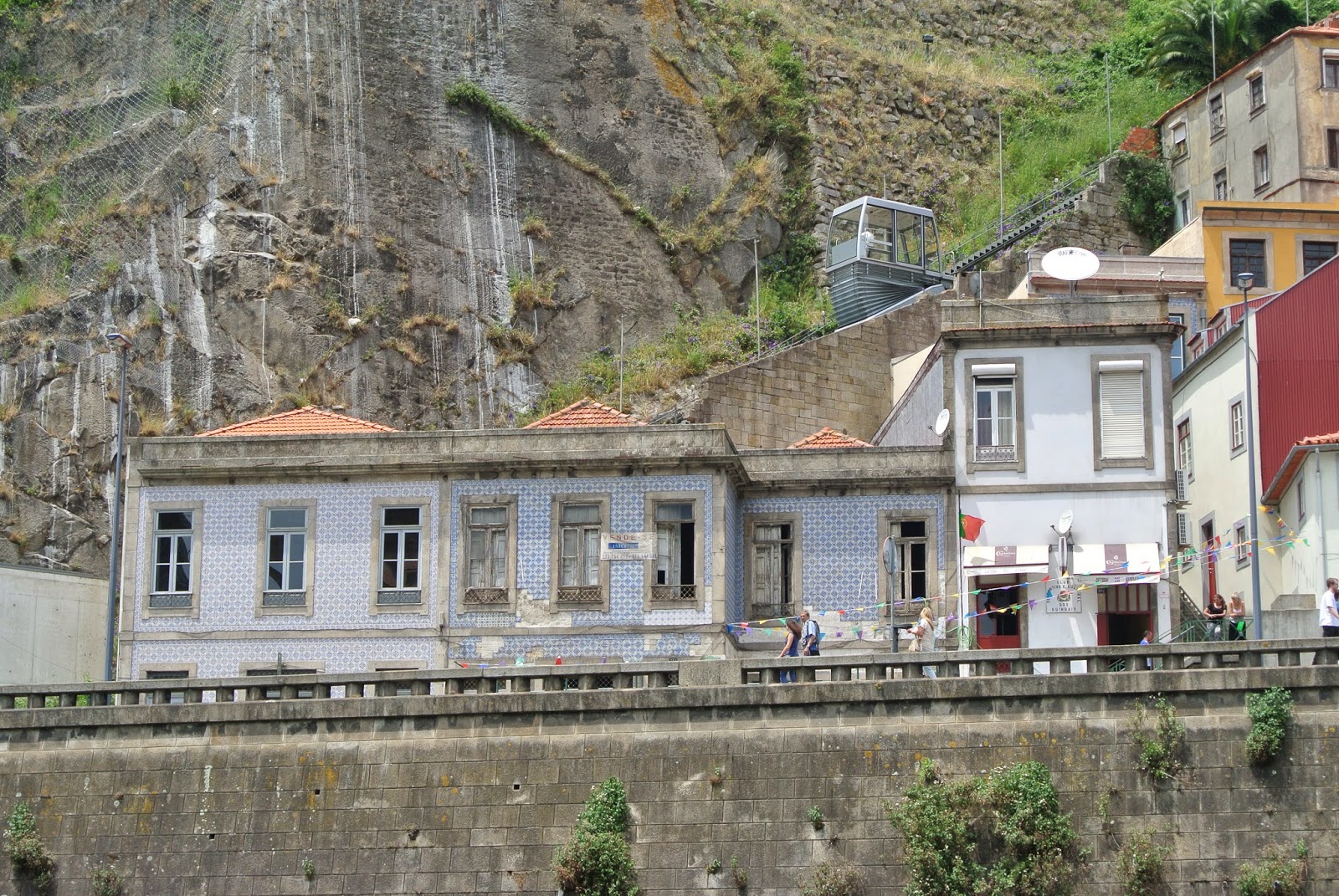
Porto- Port Wine in and out of Portugal (now with photos)


What you know about Porto is probably, about the same as I knew before I went there. It is a big port, and if you are really knowledgeable, you know that Port wine began there, and they make the best of it still. But Porto is a medium sized city, very old, built on hills, known for tile decoration on their homes, bacalau (or cod fish cuisine).

We (myself, Donna, Lennie and Bill) took the three hour bus ride straight south from Santiago and arrived about 2:30 PM. Since Bill has not been walking so well, I did my research and found a four star hotel, just 2 blocks from the bus station and a block from Casa de Musica. The music hall is an askew piece of modern concrete architecture that features many kinds of music, we are told. Hotel de Musica was a beautiful four star hotel housed next to a Portuguesa gourmet food court, and we spent our first two hours in Portugal eating tapas and Portuguese delicacies as well as delicious Portuguese wine. Our hotel room was late to be ready, since it had been full the night before, so we spent our time constructively or at least deliciously.

After the meal, the other three napped and started walking toward the river, maybe 2 miles away. I found myself on a ridge overlooking the city and the river at the Pavalhau Rosa Mata and the Museu Romantique. The new Romanesque building was surrounded by gardens, sculptures, and pheasants as well as live kissing lovers.  Unfortunately the terraces did not open up to any stairway.  I meandered my way to the center of town as again, it began to rain, a little harder than the previous day. Fortunately I found a store where I could buy a small umbrella. I used my sometimes fair sense of direction, to walk back to area near the Monumento aos Herois de Guerre de Peninsular visible for at least a mile down the Rua da Boavista. Perhapsat one time Boavista was a wide street but this century, the sidewalks were barely wide enough to walk on, and the two lanes of traffic squeezed past one another.

It was my turn to take a nap, and when I awoke, Donna said that Ana Moura was singing live in downtown Porto. The cab driver, born in Angola, got a great kick that Bill could speak so many languages, and we really enjoyed his company, and we his. Ana Moura, Fada singer from Portugal- where do I begin? Donna had heard about her the previous year, and what a voice! I find myself without words to describe this singer. I can only say that when she sang Fado, it did to me, what it does to many. It made me cry uncontrollably. No singer has ever done this to me. I cannot explain it. I can only recommend that you follow her link on this page. I might add that she is also very beautiful. It was extreme good fortune, and a chance conversation by Donna with someone in a bookstore in Porto that brought us to this place and time.  Despite a light rain, this was the extreme highlight of my visit to Porto.
I knew that the above events were more than enough for any day. Yet, this particular evening happened to be the evening of the World Cup (Copa Mondial) match between Portugal and United States began this evening at 11 P.M. Large screens and chairs were set up all over Porto and probably Portugal too. When we returned to the hotel, a crowd of people watched on five different screens. We arrived just as Portugal had scored its first goal. We managed to get a place to sit. Just before the first half, the USA scored a goal. The mood of room changed.  Early in the second half the USA scored another goal. As the game got to within minutes of the end, the mood of the Portuguese watchers turned from tense to grim and silent. In the last seconds the Portuguese team scored a goal to tie the game.  The next day the hotel concierge said that he was miserable about the outcome of the match.

Just a note: Portuguese know English on the whole much better than they know Spanish. Few of the Spanish that we met speak very good English. Many Portuguese speak excellent English.
We planned to take the tour bus of the city. Our hotel recommended the Blue Line.  We got on someplace near the Casa Musica, and drove through some of the newer parts of Porto- north then west to the Atlantic. We stopped at a beach for about an hour.  A cute fort dominated the area, built early in the 19th century by those in power, later overtaken by some “liberal rebels.” In the distance young people played on beaches, farther on signs of giant cranes of a port, father on the smoke stacks of industrialization. Some people sunned themselves, many walked along the concrete and wood walkway next to the ocean.  Competent graffiti adorned some of the industrial sized breaker walls along the coast.  I saw no one swimming but a life guard watched at a central beach. Donna confided to me that she wished that she had actually jumped in.

We drove from the Atlantic coast to the banks of the River Douro.  High cliffs nestled little villages, old factories, quaint houses and churches along the shores. The city of just over a million was one of the earliest ports in Europe and the city itself holds the honor of a World Heritage Site. We weaved our way through the tiny streets lined with people busy preparing for the upcoming Sao Juan festivities. We crossed the S. João Bridge to visit the west side of the city. We disembarked to have a traditional lunch. Bacalau is the Portuguese word for cod. We had it prepared two different ways, one grilled with whole potatoes and peppers and the other in a white sauce with light cumin and garlic. Both were some of the best food that we have had on our trip.

We then took a boat ride up and down the river.  We got a good dose of Portuguese history and geography- the history of the shipbuilding industry, the rise and fall of the ceramic tile industry and the still booming making of Port wine. We could see busy people on both sides building stages and setting up the sound system for evening festivities. Unfortunately we had to catch a bus back to Santiago. Lennie and I did try to make a stop for the Port Tour, but the one in English was 90 minutes away.  We did make a stop at the oldest Port makers in Portugal, Kopke. I  bought a bottle of Kopke Reserve Tawny Port (10 years old). I spoke to the pourer about how impressive the collection was on display, Ports from as far back as 1960 on sale. I spoke about I still had a bottle of 1980 at home. The pourer volunteered that we should taste some of the 1978. “Is that possible?”, I said. “Of course.” And so I had a good size glass of port from the year that I came to California- and the year of birth of our host. DELICIOUS

I flagged down our blue tour bus. The woman said that this was the last bus and would not make it all the way back to our first stop. Bill was getting a little anxious that we would not get back to the bus station in time. The streets seemed to be erupting in the excitement of the festival- traffic was becoming backed up, firecrackers were going off, people were starting to arrive in the old town in droves. We got in the taxi and the driver spirited us away from this buzzing center of activity.

We got back to Santiago just as it was getting dark- the smoke of the celebration permeated the air, as in Galicia they celebrate the same feast of Saint John- here San Juan. We ended the evening sipping the delicious port I had bought along the river in Porto. 


Santiago- Saturday, June 14, 2014


The last in the previous evening (1:30 A.M.) were the first up and out Saturday morning. We had decided the evening before that we would take an overnight visit to Porto, Portugal on Sunday and Monday. I decided to join Donna to get tickets. We had walked to the old town by 8:30 A.M. and ALSA bus ticket office was the same place as the pilgrim’s destination. Pilgrims lined up for their “official stamp”, and in the mean time we found a hostel called “Suso’s”. We later found out that “Suso” was a nickname for “Jesus”. “Hey, Suso,” I guess they would shout. Tickets for Porto were 45 Euro each, round trip. We would leave at 10 A.M. Sunday and come back at  7 P.M. on Monday.

I saw that there was an archeological tour as a part of the visit to the Cathedral Museum. I talked Truckee into joining me. We later found out that tours were only given early in the morning, nevertheless we opted for the museum. The most interesting part for me was the beginning. Apparently a lot of digging had been done under the cathedral and a large intricate map labeled major findings. We could hardly read anything. Yet we surmised that before the Cathedral was built there was a church there and before the church, probably a Druid burial ground as there were illustrations as if bodies had been found together.

As I may have mentioned previously, the Cathedral was built in successive waves. An impressive part at the beginning of the tour was a reconstruction of a priest’s conclave. They sat, maybe 30 of them around three parts of a rectangle in a highly formal and ornamented setting. The parts had apparently collapsed many hundreds of years before and it was lovingly reconstructed with molds from the old parts.
Among the more interesting items in the museum were a collection of relics of the kings of Spain in a variety of reliques. God knows what they saved. There  were large tapestries, several of which designed by Goy; an archive of books, some of which seemed very old- some religious, of course, but also some about nature, geography and science. More than the items themselves I enjoyed the internal architecture, the cloister where three large bells were stored, successive floors and room that may have used as a refectory, dormitories, meeting rooms and perhaps even private residences for priests.  At one point we were able to come in several places on porticos and take in new views around the Cathedral and square.
After the museum Truckee and I meandered around some of the old streets and found new interesting nooks. I found a store that showed traditional Galician costumes and I know that Donna was interested so I tried by way of photos to describe its position. Donna got lost looking for it, so my efforts were not so successful. Truckee and I wandered out of the old town and found an alternative way home that featured some less appealing and more modern architecture. Truckee did love the look of the abandoned hospital and tried to enjoin me to explore the inside. I had no desire.

We have become accustomed to a daily sometimes light, sometimes heavy rain shower. This happened as we were walking back. Fortunately it never got to be more than a minor annoyance. Two days before I had walked to the other side of town to find a grocery store. This day Truckee showed me one right in the neighborhood. I had hoped to buy some fish, as I had seen them fresh in the market, but alas, only frozen. I bypassed the frozen food for some chicken, vegetables and of course a bottle of wine.
If it seems that I going on and on about every day details, I am. I am sitting on the bus from Porto, Portugal to Santiago, with an abundance of time and more stories to tell. I will cut to the chase by summarizing the day and moving on.

I cooked dinner- much appreciated by the family- we conversed, took photos. Then Donna and I went out again to look for live music. We found it in the cellar of a tavern called Agramoda. We squeezed ourselves into the middle of the crowd and listened to several gaita players, a tambora, a traditional snare, which I hope to take up soon and a bass drum.  A young man was showing a young woman how to play the drum. Before long she was proving herself quite descent on the instrument. Some players traded instruments, and played just as fluently on each.


Saturday, June 21, 2014

Santiago de Compostela- end of Day 1 and Day 2


Evening of Day 1

Suzanna is a traditional dress maker, dancer, accordion player and singer. We met her through Cano, a gaita player that Donna knew from our days at Lark in the Morning Mendocino Music Camp. She offered us a wonderful apartment just above hers for our stay in Santiago. This particular evening she recommended that we come out with her, have dinner and listen to she and her friends sing traditional Galician and Spanish songs.  The restaurant was in a small town rural setting, all stone and lovingly cared for.  Suzanne proudly showed us the largest stone oven in Galicia, now used as a small dining room. We sat at a table as Suzanna and her four friends sang folk songs the entire time. The master of the house and the restaurant brought us a variety of grilled meats and appetizers fresh off the grill. We ordered a variety of Galician seafood and enjoyed tasting a great variety of grilled vegetables, large prawns, scallops, potatoes, and… As it got later things loosed a bit. Bill, Donna’s dad sang along with some of the pieces he knew- Spanish, Mexican, Venezuelan, Peruvian- even coming around to an American pop song where I filled in the lyrics that the others did not know. Donna sang a beautiful traditional Mexican song that she knew.  This went on until near midnight.   

Day 2
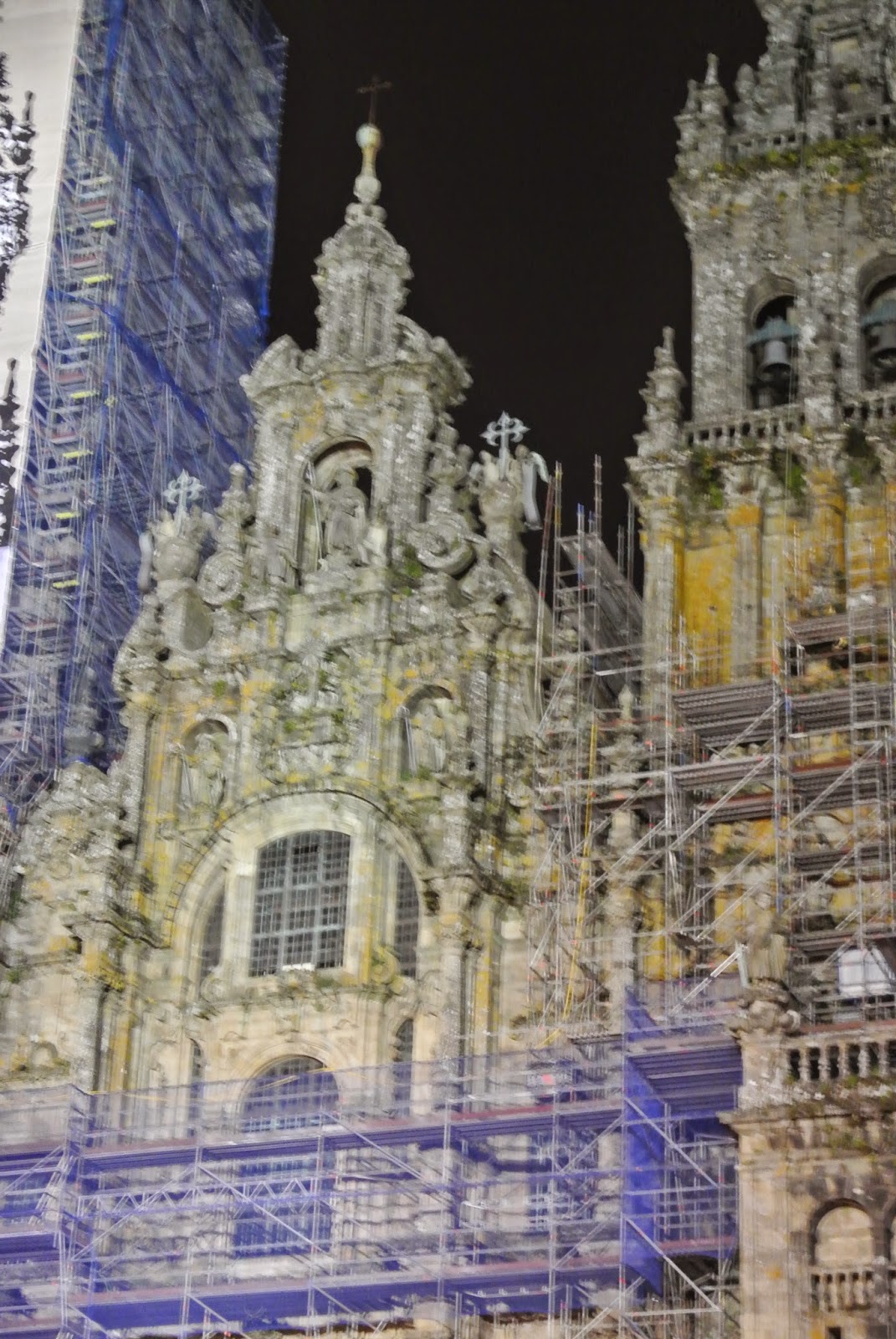
Truckee made arrangements the previous day for a highly touted Cathedral rooftop tour. One small detail was that the tour was entirely in Spanish and none of the four of us understand more than the simplest Spanish. It is unfortunate that the Spanish tour appeared packed with information that we could not understand, as the guide gushed on and on about the history and beauties of the top of the Santiago Cathedral of Saint James, the Apostle.

The tour promised wonderful views and we did have those. We climbed maybe 200 steps and came up on a stone tiled tilted roof, level enough to walk on at least fairly safely. Nestled in the Galician countryside, this city has a great deal of character, the red tile roofs, white stucco, broad fields, stands of oaks and broad expanses of green countryside. The one bit of Spanish we did recognize was when a Spanish tour taker climbed a roof peak, to impose himself on a cross for a photo op. The guide loudly interrupts her monologue with a firm “ por favor!!!!”. The errant tourist ejects himself quickly from the cross, just after the photo op. I got a photo of it too.

We then took a walk through the streets (or Rua- in Galician) of Santiago. Nearby was an extensive outdoor and indoor market with many fresh fruits, vegetables, flowers, fish and meats. I vowed that I would buy some of those fish soon and cook a family dinner. With family days become pleasantly lazy. We walk a little. We have a long delicious lunch with a little wine or beer, take a little nap, then walk a little more, and sit down and eat again.


Donna had heard that there was some live music just down from the Cathedral. The group was two gaita (bagpipe) players, a drummer and an accordion player. At one point I got up to speak to them and told them that Galician music was very popular in our part of California. They, of course, knew Cano, but also asked if I knew Keven Carr. I know him very well. They knew Molly even better, Kevin’s lovely daughter. They were excellent musicians and played much of the time in harmony.  As the night went on, teenagers started to arrive in droves. We were about to leave, when our waiter suggested that we must stay for the best part. A ceremony would begin, honoring the Druid spirits of old, casting out bad spirits, lighting the alcohol and dancing. The owner brought out a big ceramic bowl and lit it. He stirred it for a while, dripping the liquid fire with his spoon. Out came our waiter, dressed in Druid straw. (See the photo.) Suddenly the band struck up the music, he started to dance and almost immediately pulled Lennie in with him. He urged us to get up and dance and we did, as the rest of the dinners clapped. It was exhilarating and just plain fun. The waiter did not want us to pay for our share of sweet alcohol, because we were part of the show. We tipped him what we would have paid. It was a grand night. We walked home and Donna suggested that we go out again, just the two of us, and look for music. We walked the lovely streets, and then on our way home heard the characteristic sound of the gaita. A five person group was playing in a pub.  They were toward the end of the festivities, as a similar bowl of alcohol was there and emptied with some glasses around it. This lively band was in town to record a CD, and Donna said that she had seen them playing on the street much earlier. The managed to rouse the entire audience to their feet, gaita, bass drum, little snare and tambora.  Yet again a wonderful musical evening.